If you’re looking for boat access on Lake Marble Falls, one of the first things I want to know is what boat access actually means to you. Are you picturing walking out your back door, lowering your boat from a lift, and being on the water in five minutes? Do you want to swim and paddleboard from your dock? Are you primarily interested in the view and the experience of living on the water? Or would you be perfectly happy living near Lake Marble Falls, keeping your boat stored elsewhere, and using a public boat ramp whenever you’re ready to get on the water? Those are very different versions of lake living, and understanding which one you’re looking for can completely change the properties we should be considering.
Lake Marble Falls also works differently from Lake LBJ or Lake Travis. You don’t have the same large, full-service marina environment with covered rental slips, fuel docks, and restaurants where you can routinely pull up by boat. That doesn’t make Lake Marble Falls less desirable. In fact, I think its smaller size and more intimate setting are part of what makes living here special. But it does mean you need to understand how boat access on Lake Marble Falls actually works before buying a property based on assumptions you may have developed from boating or living on other lakes.

Waterfront and Water Access Are Not the Same Thing
This is probably the first distinction I make with buyers because wanting to live on the water is completely different from wanting to live near the water. If your goal is simply to own a boat and enjoy Lake Marble Falls, you don’t necessarily need waterfront property. You can live nearby, store your boat at home or at a storage facility, and use one of the public boat ramps. That can give you access to the same lake without paying the premium that generally comes with owning waterfront property.
If what you’re imagining is walking into your backyard, swimming from your dock, having your boat on a lift, sitting beside the water in the evening, and looking across the lake every morning, then we’re talking about something entirely different. Even then, I want to know what waterfront means to you. Do you want true open water? Would a canal or narrower waterway work? How important is swimming? Do you own a boat, Jet Ski, WaveRunner, kayak, or paddleboard? Are you primarily looking for views, or is boating the reason you’re buying on the lake?
I don’t start by trying to fit a buyer into a particular waterfront property. I want to understand how you imagine using the water first because that helps us determine where on Lake Marble Falls we should be looking, what physical characteristics the property needs to have, and what you’re likely going to need to spend to get the experience you want.
Public Boat Access on Lake Marble Falls
If you don’t need to keep a boat at your house, there are public boat ramps that provide access to Lake Marble Falls. Three of the primary public access points are Johnson Park, Lakeside Park, and the Cottonwood Shores boat ramp.
- Johnson Park has a single-lane concrete boat ramp into Backbone Creek. It’s a popular access point with park amenities, but parking is limited and the area can become congested.
- Lakeside Park, just west of the US 281 bridge, has a three-lane concrete ramp and a larger park setting. It’s another popular launch point, although on-site truck and trailer parking is still something you need to consider.
- Cottonwood Shores maintains a single-lane concrete boat ramp at 3729 Lakeview Drive. Its location makes it particularly useful for properties toward the western end of the lake, and it has paved parking with greater trailer capacity than the Marble Falls park ramps.
Which ramp makes the most sense isn’t simply a matter of picking your favorite. It depends on where you live, where on the lake you want to spend your time, parking availability, congestion, the time of year, and what may be happening around the lake that weekend. During major events, access can also change. LakeFest is an obvious example because recreational watercraft activity is restricted during the racing events.
And wherever you’re launching, remember that getting the boat into the water is only half of the equation. You also need somewhere to leave the truck and trailer. Parking availability and security are considerations at any public boat ramp, particularly on busy weekends when everyone else has the same idea you do.
Trailering a Boat Is a Realistic Option
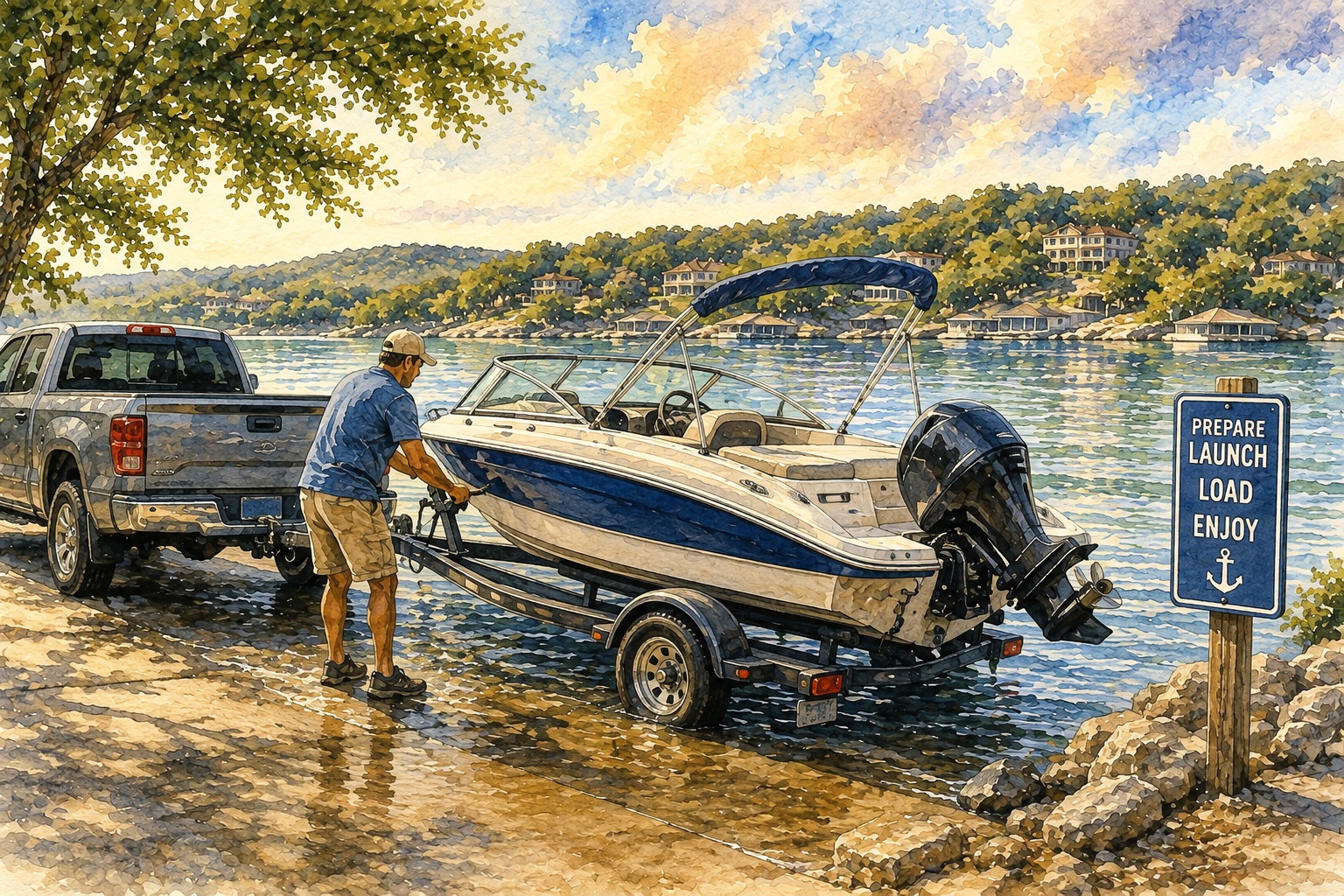
You may be surprised by how many boat owners don’t live directly on the water. Trailering a boat to Lake Marble Falls is completely reasonable, particularly if you don’t use it every day or every weekend. It can also open up considerably more housing options because you aren’t limiting your search to properties with usable waterfront and private docks.
There is, however, a convenience calculation. You have to get the boat out of storage, hook up the trailer, drive to the ramp, launch it, find somewhere to park the truck and trailer, retrieve everything when you’re finished, drive home, and put the boat away again. Compare that with walking into your backyard, lowering your boat or personal watercraft into the lake, and going. Both get you onto Lake Marble Falls, but they are completely different experiences.
I grew up living on a lake, and our dock allowed us to raise our boat above the walking area into an enclosed space where it had greater protection from wind and weather. We could walk outside, drop the boat or WaveRunners into the water, and go. Once you’ve experienced that kind of access, you understand why a usable private dock can be such an important feature of a waterfront property.
That doesn’t mean you have to use your boat every Saturday to justify living on the water. Life gets busy, schedules change, and you may use the boat constantly one summer and much less the next. Living on the water is an experience in itself. The view, swimming, sitting on the dock, entertaining outside, watching the weather move across the lake, and simply having the water as part of your backyard can have value even on the days when the boat never leaves the lift.
Not All Lake Marble Falls Waterfront Is the Same
This is where looking at listings online can get you into trouble. Two properties can both be described as Lake Marble Falls waterfront and provide completely different experiences once you step into the backyard. The MLS checkbox may say “waterfront” on both of them, but that single word doesn’t tell you much about the water itself.
The eastern portion of Lake Marble Falls generally has wider, deeper water and a more defined shoreline, which tends to make it better suited to boating and traditional water recreation. The area around the US 281 bridge is particularly popular with boaters, and portions of the mid-lake area receive heavier recreational use. If open water and easier navigation are priorities, these are characteristics I want to consider as we’re evaluating properties.
As you move farther west toward Cottonwood Shores, Lake Marble Falls becomes more river-like. The water can be shallower, and sandbars and underwater conditions become more important considerations. That doesn’t automatically make one part of the lake better than another. It means where you buy should match how you want to use the lake. Someone primarily interested in a peaceful waterfront setting may evaluate a property very differently from someone with a larger boat who wants easy access to deeper, open water.

Water Depth Matters
Whenever you’re buying waterfront property, water depth needs to be part of the conversation. A dock sitting behind a house doesn’t necessarily tell you whether the water underneath or around it works for your boat. You need to consider how deep the water is, what the lake bottom is like, whether there are sandbars or underwater hazards nearby, and what happens to usability when the lake level changes.
Most importantly, we need to consider the watercraft you’re actually planning to put there. A buyer with one fishing boat has different requirements from someone with a larger boat, two Jet Skis, and paddleboards. That’s why I separate two questions when we’re evaluating waterfront property: ‘Can I have a dock here?’ and ‘Will this dock actually work for the watercraft I own?’ Those aren’t necessarily the same question, and finding out the answer after you’ve purchased the property is a little late.
Don’t Assume You Can Just Add a Dock Later
One of the assumptions I don’t want a waterfront buyer making is, “There’s no dock, but I’ll just add one later.” There is a lot hiding inside the word ‘just’. Lake Marble Falls is regulated, and docks, shoreline improvements, and related structures have requirements that need to be investigated for the individual property. For example, docks on Lake Marble Falls cannot extend more than 35 feet from the shoreline, but that’s only one consideration.
Construction materials, location, safety standards, shoreline conditions, submerged-land rights, and applicable governmental or association requirements can all come into play. Requirements can also depend on the size and type of structure you’re proposing. Waterfront ownership does not give you carte blanche to build whatever you want along the shoreline simply because you own the property in front of it.
Before buying a property with plans to add or substantially modify a dock, I want the current requirements investigated for that specific property and for the improvements you’re contemplating. I’d much rather have us discover a limitation while we’re doing our due diligence than have you discover after closing that the dock you were picturing isn’t going to work.
An Existing Dock Doesn’t Eliminate Your Homework
Finding a property with an existing dock is great, but it doesn’t mean our work is finished. Now we need to investigate the dock itself. I want to know about the structure, its condition, boat lifts, electrical components, shoreline improvements, retaining walls, and any signs of deferred maintenance. We also need to investigate applicable LCRA documentation, permits or leases, whether existing approvals transfer when required, and whether modifications to the dock or shoreline were properly handled when they were constructed.
Then there is the most practical question of all: ‘Does the existing dock actually work for you?’ If you own a particular size boat, multiple Jet Skis, or other personal watercraft, we need to evaluate the property with those requirements in mind. A beautiful dock that doesn’t accommodate what you own isn’t necessarily the amenity it first appears to be.
Inspect the Dock and the Shoreline
I recommend having waterfront structures properly evaluated rather than assuming the regular home inspection tells you everything you need to know. The dock itself is only part of the equation. Boat lifts, electrical systems, structural components, retaining walls, and signs of deferred maintenance deserve attention because these can become expensive items when they’ve been neglected.
The shoreline itself matters too. Cracking, crumbling, movement, erosion, or neglected shoreline improvements can become significant problems. You also want to investigate whether shoreline modifications were appropriately approved and whether there are conditions that could affect future maintenance or improvements. Waterfront property gives you something special, but it also gives you additional components of the property to maintain, and I want those evaluated with your eyes open before you make the property yours.
The Walk From the House to the Water Matters Too
Here’s something buyers sometimes don’t fully appreciate until they’re standing on the property: the lake may be right behind the house, but getting from the house to the lake can be another story. Slope matters, and it can affect both how you use the property and what buyers are willing to pay for it.
A relatively level backyard leading toward a dock provides a very different living experience from a steep descent requiring numerous stairs. Think about carrying coolers, towels, paddleboards, water toys, food, and everything else you might take between the house and dock. Then think about making that same trip several times during an afternoon.
This is why I don’t just look at whether the property touches the water. I look at how you’re actually going to ‘live between the house and the water.’ The relationship between the house, backyard, shoreline, and dock can be just as important as the fact that the property technically qualifies as waterfront.
Swimming From Your Own Dock
Swimming is another reason some buyers want private waterfront rather than simply boat access. Being able to walk into your backyard and get into Lake Marble Falls can be a significant part of the experience, particularly for buyers who imagine family and friends spending summer afternoons around the dock.
Just like boating, however, swimming conditions can vary from one property to another. Water depth, vegetation along the shoreline, underwater conditions, currents, and nearby boat traffic can all influence how enjoyable a particular property is for swimming. If swimming from your dock is something you picture yourself or your family doing regularly, that’s information I want to know before we start narrowing down properties.
Lake Marble Falls Is Better Thought of as a Managed-Level Lake
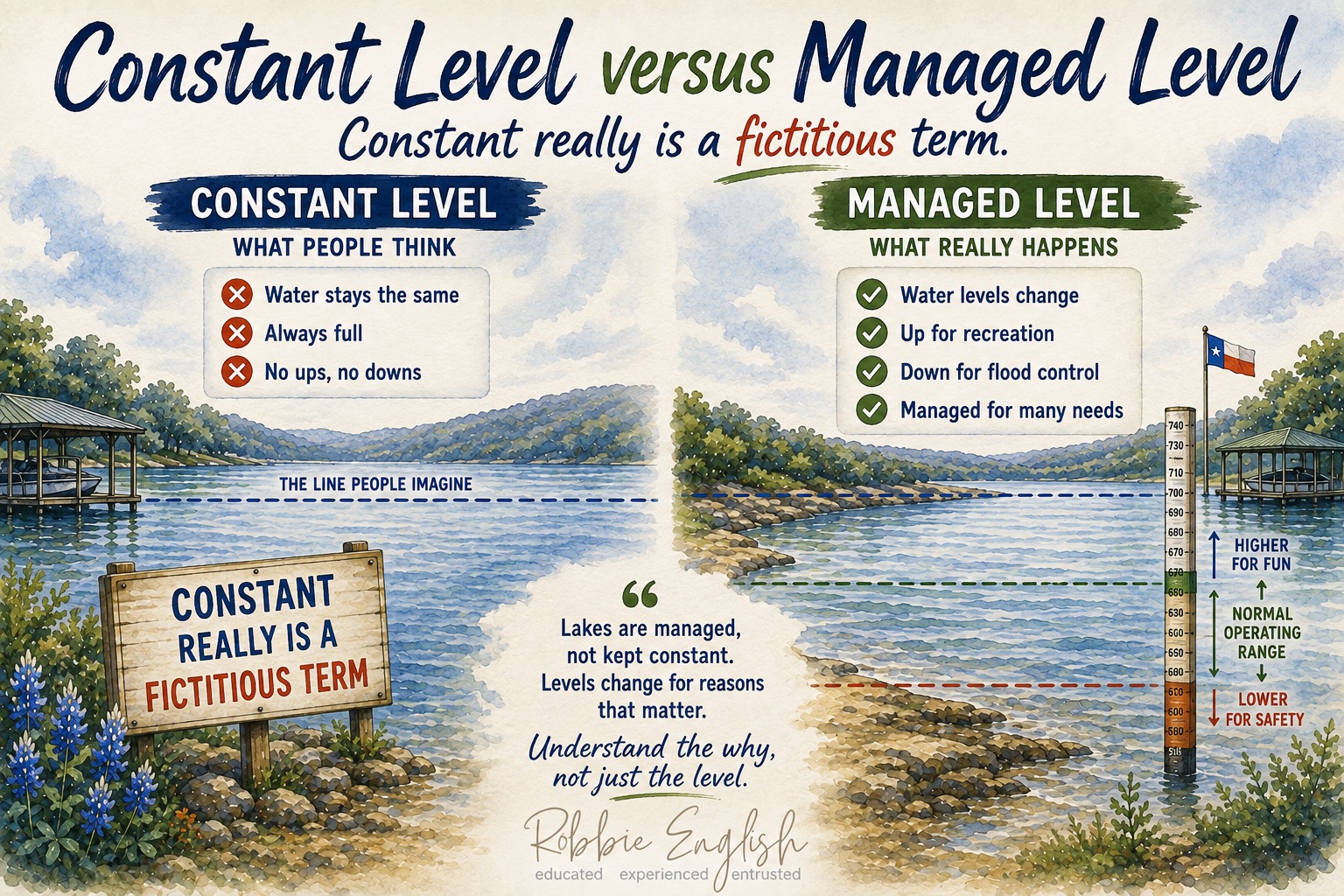
You’ll frequently hear Lake Marble Falls described as a “constant-level lake”. I personally do not like that terminology and prefer to call it a ‘managed-level lake’ because the usage of the word “constant” makes it sound as though the water level never changes, and that’s not what happens.
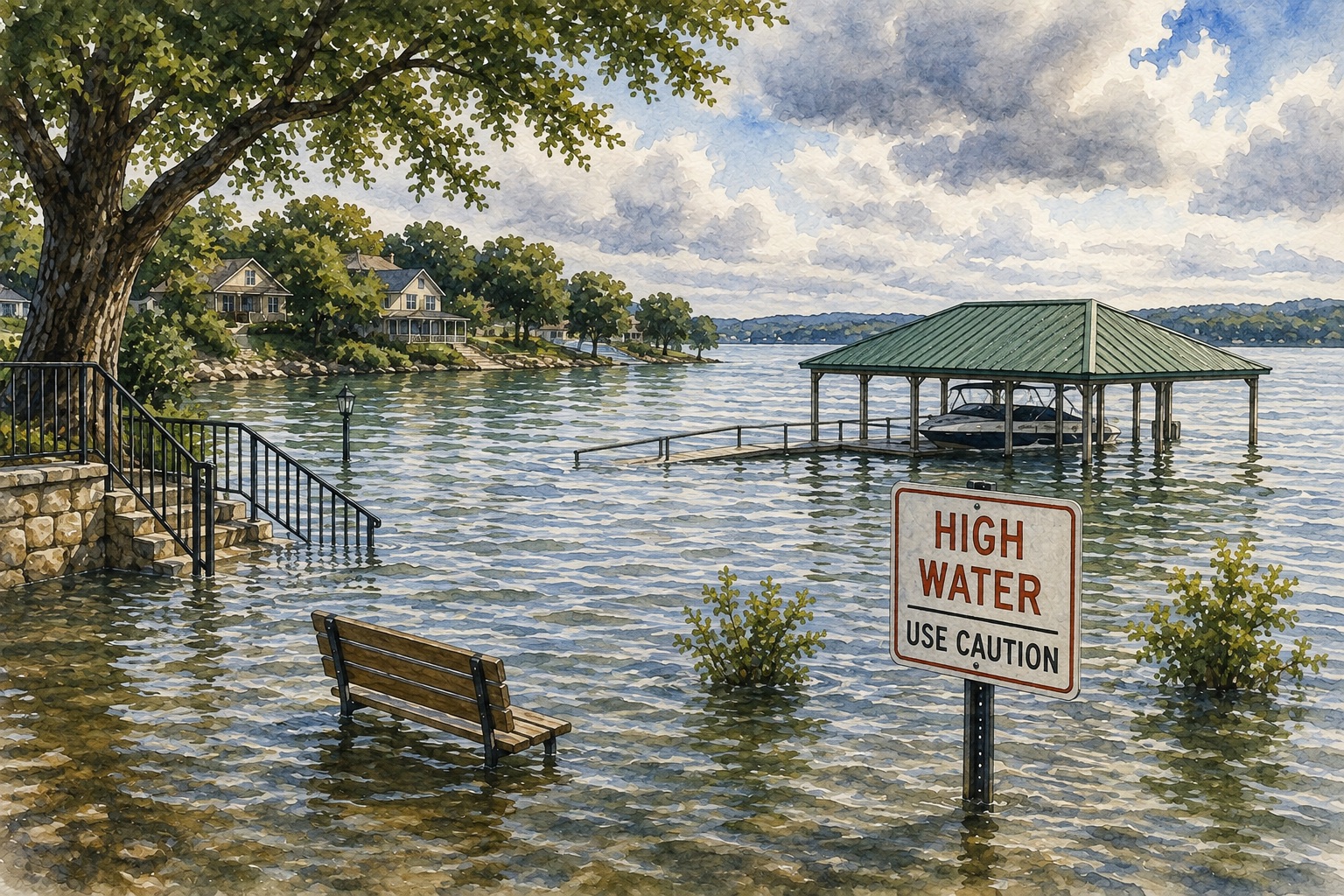
Under normal conditions, LCRA manages Lake Marble Falls within a relatively narrow operating range, but flood events, upstream water, dam operations, and intentional lake lowerings can all affect water levels. Lake Marble Falls doesn’t have a large amount of extra capacity available for floodwater storage, and Central Texas flash-flooding events can cause water to arrive quickly. LCRA can also intentionally lower the lake when necessary for maintenance, dock and shoreline work, dam projects, and other purposes. Lake Marble Falls was intentionally lowered in October 2022 in connection with work involving Max Starcke Dam.
So when you hear someone use the phrase “constant-level lake,” don’t interpret that to mean the lake is physically incapable of rising or falling. I think of me and my explanation of it being a “managed level” will give you a much better understanding of what is actually happening. The water is managed, not frozen at one elevation.
Floodplain Is Part of the Waterfront Conversation
If we’re talking about buying property on Lake Marble Falls, we’re also going to talk about floodplain and elevation. That’s not meant to scare someone away from waterfront property. It’s part of understanding what you’re buying and making sure you know how the property relates to the water during conditions other than the beautiful sunny afternoon when you’re standing there looking at it.
Where does the house sit relative to the water? What portions of the property are within applicable flood areas? How could a significant upstream weather event affect the property? What should you understand about insurance? Central Texas weather can change quickly, and pass-through floodwaters from upstream can cause rapid changes in lake conditions. Waterfront living is wonderful, but part of owning waterfront responsibly is respecting the water rather than pretending it can’t change.
Boat Storage Matters If You Don’t Have a Dock
If you’re going to trailer your boat, where are you going to keep it? That’s a question that needs an answer before closing because many neighborhoods have restrictions concerning the visible storage of boats, trailers, and RVs.
Meadowlakes, for example, restricts boats, trailers, and RVs from being stored in plain view and generally requires them to be appropriately screened or stored within an enclosed area. A neighborhood restriction like that can create another consideration if the property doesn’t have suitable storage. Commercial boat-storage facilities are available in the area, but now you’re adding storage costs and another stop between deciding you want to go boating and actually putting the boat in the water.
None of these options is necessarily wrong. Some owners would rather keep a boat at a storage facility than pay the premium for waterfront property, while someone else may consider walking out the back door and lowering the boat into the water one of the primary reasons they’re buying here. It’s about knowing which arrangement fits your lifestyle before we start looking for the house.
Lake Marble Falls Doesn’t Have a Traditional Marina Lifestyle
This is another expectation worth resetting if you’re accustomed to boating on larger recreational lakes. There isn’t an on-water fuel dock on Lake Marble Falls. Mobile fuel delivery services may be an option for some boat owners, but you aren’t going to cruise over to a traditional marina fuel dock the way you might expect elsewhere.
There also isn’t a collection of restaurants where you routinely pull the boat up, tie off, and walk inside for lunch or dinner. There are restaurants near the banks of Lake Marble Falls, but that’s different from having dedicated boat-up restaurant access. If the marina, restaurant, and larger recreational boating environment is central to what you’re imagining, Lake LBJ may be closer to the experience you have in mind.
Lake Marble Falls Versus Lake LBJ for Boating
I don’t look at Lake Marble Falls and Lake LBJ as competitors where one has to be declared the winner. They provide different experiences, and because they’re so close to one another, living around the Highland Lakes gives you access to both.
Lake LBJ is larger and, in my opinion, more recreation-oriented. Its size provides more alternatives for boaters, and it has more of the infrastructure people commonly associate with a recreational lake. Lake Marble Falls feels more intimate to me. It’s a little over 5.5 miles between the dams, and its smaller size creates a different environment. You can boat from one end to the other, although you always need to remain aware of shallower areas, underwater hazards, currents, and changing water conditions.
Certain activities may simply make more sense on Lake LBJ. Wake surfing is a good example. Lake Marble Falls isn’t particularly large for that type of activity, and large wakes can create issues for other boaters, docks, and shorelines. For more intensive wake activities, I would generally look toward a larger lake such as Lake LBJ. The good news is that choosing to live on Lake Marble Falls doesn’t require Lake Marble Falls to provide every recreational experience you enjoy. Lake LBJ is nearby, which gives you options.
Private Boat Access Has Value
There’s a reason usable waterfront and private docks can command a premium. You’re buying more than dirt and a structure. You’re buying convenience and an experience, and the quality of that experience can vary significantly from one property to another.
Deeper usable water can affect desirability. So can the condition and type of dock, boat lifts, shoreline condition, slope, views, orientation, and how easily you can move between the house and water. A property where you can comfortably walk outside, lower the boat, swim from the dock, and enjoy deeper open water offers something different from a property where the shoreline is difficult to reach or the water isn’t particularly usable for the buyer’s needs.
That doesn’t mean every waterfront buyer needs the most elaborate dock or deepest section of Lake Marble Falls. It means waterfront amenities are part of the property’s value and should be evaluated just as thoughtfully as the house itself.
Five Questions I Ask Buyers Who Want Boat Access on Lake Marble Falls
When someone tells me they’re looking for a home with boat access on Lake Marble Falls, these are some of the first questions I want answered:
- What type of water access do you actually want? Do you want your own shoreline and dock, or do you primarily need convenient access to a boat ramp?
- Do you understand the difference between the deeper and shallower portions of Lake Marble Falls? Where you are on the lake can change the boating experience.
- Do you want open water, or would a canal or another type of waterfront work for you? The word “waterfront” can describe very different properties.
- What size boat and other watercraft do you own? I want to understand what we’re trying to accommodate before deciding whether a particular dock or property works.
- Do you want to keep your boat and watercraft at your property, or are you comfortable storing and trailering them? That answer can completely change the properties we should be looking at.
Those questions aren’t meant to complicate a waterfront search. They’re meant to keep us from solving the wrong problem. If I understand how you want to use Lake Marble Falls, I can do a much better job of helping you identify the properties that actually fit that lifestyle.
Before Buying Lake Marble Falls Waterfront, Do the Homework
Buying waterfront property adds another layer of due diligence. Depending on the property, I may want us investigating:
- Water depth and underwater conditions
- Existing dock construction and condition
- Dock approvals, permits, leases, or other applicable documentation
- Whether applicable dock rights or approvals transfer
- Boat lifts and other watercraft equipment
- Shoreline and retaining-wall condition
- Prior shoreline modifications
- Floodplain and property elevation
- Septic system condition and requirements
- Neighborhood or HOA restrictions
- Boat and trailer storage
- The slope between the home and waterfront
- Whether the property actually accommodates your boat and intended use
Every property is different, which is why I don’t like making broad assumptions about what someone can or cannot do simply because a listing says “waterfront.” The purpose of due diligence is to identify those questions while you still have the opportunity to investigate them, not after you’ve already fallen in love with the view and moved your furniture in.
Finding the Right Boat Access on Lake Marble Falls
Boat access on Lake Marble Falls isn’t a simple yes-or-no feature. It’s a combination of where you are on the lake, the depth and characteristics of the water in front of the property, the dock or ability to have one, the watercraft you own, how you intend to use the lake, and the kind of waterfront lifestyle you’re actually trying to create.
And sometimes the right answer isn’t waterfront at all. You may discover that living five minutes from a public ramp gives you exactly what you need while allowing you to spend your money differently on the house. Or you may stand behind a waterfront home, look at the lake and the boat lift, and realize that being able to walk outside and be on the water whenever you want is exactly why you’re moving here.
Neither answer is wrong. The important part is figuring out which experience you’re actually looking for before you buy the property.
If you’re considering a home with boat access or waterfront property on Lake Marble Falls, I can help you look beyond the word “waterfront” in the listing and evaluate how the property fits the way you actually want to use the lake. I’m Robbie English, REALTOR, Broker with Uncommon Marble Falls Realty, and I work with buyers and sellers throughout the Highland Lakes.
If Lake Marble Falls is where you’re considering buying, call or text me at 830-953-5571. Tell me what lake living looks like to you, and we’ll start there.